She'd never run the deck. She ran it with sixty leaders.
Eva was an Innovation Lead. Not a facilitator. Not a coach. She had a big change to carry her leaders through, and she'd never run the Emotional Culture Deck before in her life.
She didn't wait to become an expert. She picked up the deck, she picked up the workshop, and she ran it herself. Sixty leaders. Seven offices. Her first time.
I feel that's the part worth sitting with. Not that it worked, though it did. That she was the one who ran it. Most change work hands you a plan and a consultant to deliver it. This was a leader, standing in her own room, asking her own people one honest question.
The conversation almost everyone skips
Most change work hands you a plan. Almost none of it asks how your people need to feel to come through the change well.
We spend the energy on the announcement. The all-hands, the slides, the order of the message. And then we wonder why the plan meets resistance, or quietly stalls. Change doesn't fail because of the plan. It fails because of how people feel about it. Not the timeline on the slide. What the people carrying the change actually feel about it, in the room, on the call, in the corridor.
That is the most overlooked conversation in change. It is also the one that decides whether a change lands.
What Eva actually ran
The Change Leadership Workshop is simple by design. Two hours, built on the Emotional Culture Deck, for a room of leaders. Three parts, plus a warm-up and a reflection.
- First, self-awareness. Each leader reflects on a change they've lived through, how it felt, and what they learned. So they lead from real experience, not theory.
- Then, intention setting. Using the deck, the team names how they want their people to feel through this change, and how they don't. This is the heart of it, and it turns on one beautiful question. How do we want our people to feel, and not feel, throughout this period of change?
- Then, leadership behaviours. They turn those feelings into the behaviours and actions that will create them, and name the ones to leave behind.
That's it. A room of leaders moves from their own experience of change to a shared, named agreement on how they'll lead their people through it. Built to be run by a leader, not a consultant.
Run the heart of it yourself, free
You don't need to buy anything to try this. We've put every card in the Emotional Culture Deck onto a single free page, and built the change challenge right into it. It's the same activity at the centre of Eva's workshop.
Here's the shape of it.
First, name the change. Say plainly what your team is walking into. Then choose how you want them to feel: pick five to seven cards for the feelings you want in the room as you lead through it. Then choose what to catch early: pick the feelings that tell you resistance is rising, so you spot it before it spreads. Then decide what you'll do, two or three real things that make the good feelings more likely and the hard ones easier to raise.
Do it on your own first. Then do it with your leadership team. The moment a room names how it wants people to feel, the change stops being something that happens to them and starts being something they lead.
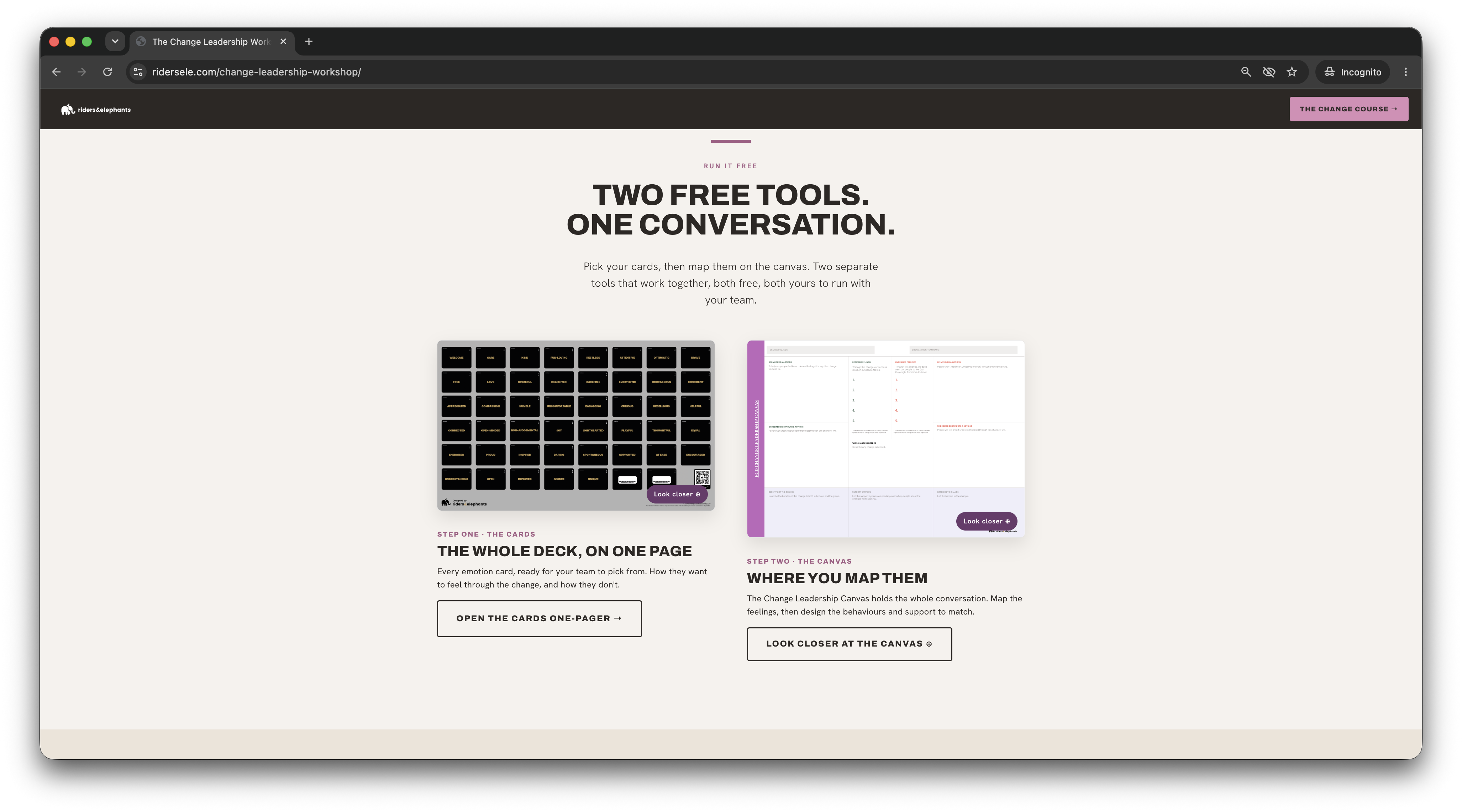
Open the free one-pager and run it yourself »
We don't just talk about emotions at work. We measure the outcomes of them. What actually moves because of the conversations we create.
Eva's workshop is one short expression of a bigger approach: name how people want to feel through change, then design for it. In a separate, longer change programme, Professor Michael Parke at the Wharton School of Business measured that same approach inside a real organisational change, before and after. Every dimension moved, and the shifts were statistically significant. These figures come from that programme, not from Eva's workshop. What they share is the method.
| +20.7% Naming the emotions people felt |
+16.4% Naming the hard emotions |
| +10.3% Leaders' emotional support |
+7.3% Overall engagement |
The emotional side of change isn't the soft part. It's the measurable part almost nobody measures.
Where it goes deeper
The free one-pager is the doorway. Inside our Emotional Change Strategy Course, the same work goes deeper, on the Change Leadership Workshop & Canvas, the done-in-the-room tool Eva's leaders used to turn feelings into a shared plan they actually owned.
Learn to lead the emotional side of change here »